Files
Download Full Text (2.9 MB)
Description
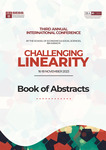
As we live in an era where the knowledge landscape is rapidly changing and becoming more complex, answering age-old questions about our society, economy, and environment has become more challenging today than ever before. In the wake of this change and challenge, falling back on linear and myopic conclusions is sometimes all too irresistible. A fatigue of imagination that leads to easy answers seems to be prevalent within several disciplines and is sometimes driven by ideological biases. Resultantly, the progress in addressing economic disadvantage, social isolation, and discrimination, psychological distress remains suboptimal often because of linear conceptual frameworks which fail to recognize institutional biases, power imbalances, and historical legacies and their differential impact on individuals and communities.
Such realizations reinforce the need to re-examine what we perceive as self-evident, the-only-logical, and the-only-workable solutions. How can we register and process the most important social, technological, economic, institutional, and environmental questions of our time without succumbing too much to linear thinking? Instead of simplifying (and undermining) complexity, how do we equip ourselves to acknowledge, embrace and work with it? In what ways does linearity manifest itself in our lives and our world? Is there a substitute for linear thinking? What are the generative possibilities of non-linearity and what fears do they evoke?
This year's conference will acknowledge these challenges and shall strive to understand how these changes and challenges are reflected in different disciplines of social sciences and deliberate on pertinent social sciences questions, particularly concerning the following themes.
Publication Date
7-2022
Publisher
Institute of Business Administration
City
Karachi
Keywords
Competitiveness, Productivity, Growth, Monetary Policy Effectiveness, Inflation, Interdisciplinary Perspectives, Media, Communication, Culture, Governance, Non-traditional Security Challenges, Food-Water-Energy Nexus
Disciplines
Behavioral Economics | Economics | Environmental Studies | Food Studies | Growth and Development | Income Distribution | Political Economy | Public Economics
Recommended Citation
Centre for Business and Economic Research (CBER)., & School of Economics and Social Sciences (SESS). (2022). 3rd Annual International Conference Proceedings: Challenging Linearity. Institute of Business Administration. Retrieved from https://ir.iba.edu.pk/conference-proceedings/4
Included in
Behavioral Economics Commons, Environmental Studies Commons, Food Studies Commons, Growth and Development Commons, Income Distribution Commons, Political Economy Commons, Public Economics Commons